Showing posts with label mexico. Show all posts

Monday, May 23, 2011

Cumbres

I am coming out of a long hiatus with some images of two mountains I have scaled in Mexico.

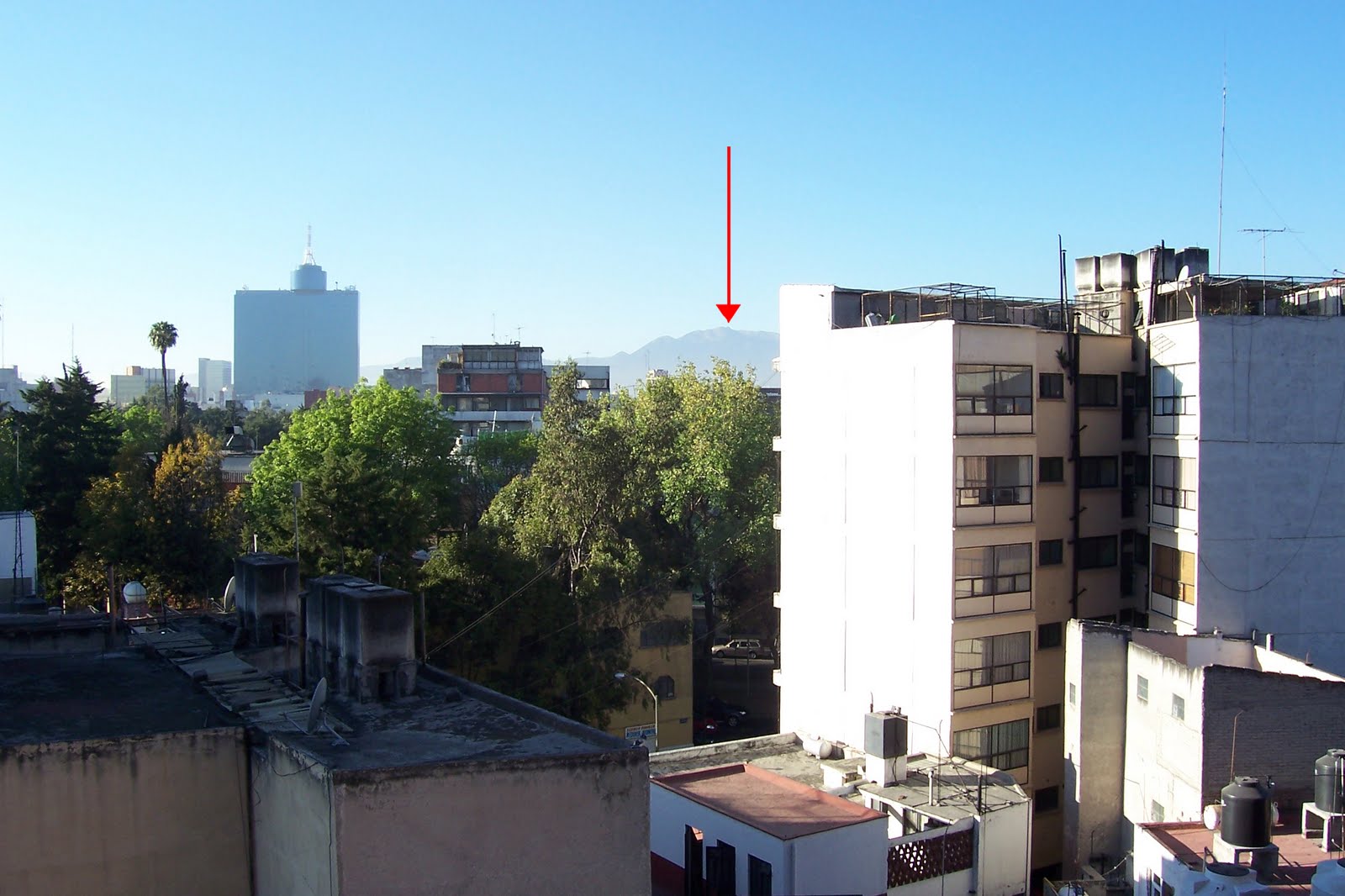
The first is the lava domed volcano Ajusco, located to the south of Mexico City, which I climbed on March 22, 2009. At 3,930 meters (12,894 feet), it is the highest point in the Federal District. As such, it is visible from anywhere in the city if one can get a little altitude (when haze and pollution do not obscure it).

I was able to see if from the bedroom of my old 6th floor apartment in La Condesa.

A closer view from an enclave of cabañas in Delegación Tlalpan. One can see that it just breaks the treeline. This area is the only part of the Federal District to receive snowfall in winter. The summit to the right is known as the Pico de Aguila (the Eagle's Beak).


At the summit, I encountered multiple crosses, which are a typical feature of peaks in Mexico, high and low.


Ajusco has a double peak: this shot of the higher peak is taken from the lower of the two. I did not realize I was climbing the lower one until I had already reached the top. While the valley in between does not seem impossible to cross, I was wanting for daylight (although I started early, I had spent the better part of the day trying to find my way to Ajusco by bus and clueless taxi, and later walking in search of a trailhead).

I took the most northern route, which leads to the lower peak. My colleagues have since informed me there are two other trails, and the western one will take you to the peak shown below. Look closely and you will see it is also topped with several crosses.


Messages left below to be read from on high.


And life flourishes in the most remote of places. The abundance of lizards in Mexico always reminds me I'm not in Kentucky anymore.


Panoramas from the summit. Fortunately, I came on a clear day and was able to soak in the view of the entire city below. It is a powerful and humbling feeling seeing all of the vast metropolis alone and in utter silence.


Proof I scaled in an unflattering picture. I went alone, which in hindsight was foolish, as the trail can convert into rockslide and the weather can shift rapidly. My descent was in twilight and I was lucky to make it back to the highway just when the sun was setting. My luck did not hold for a taxi or a bus, however, and were it not for the generosity of a family tending to their closed quesadilla restaurant in giving me a ride to the bus station, I may have had to walk it all the way back too.


The second peak is the inactive volcano La Malinche (a.k.a. Malintzin) in Tlaxcala, about two hours east of Mexico City. This I scaled with a group of 9 others last Saturday, May 22nd, 2011. At 4,461 meters (14,636 feet), it is the 5th highest point in Mexico. That's 500 feet higher than Pike's Peak and just over 1/2 the height of Mount Everest.

Here is the approach from the north


The form to the lower right is not a tepee but a granary taking advantage of the tendency of grain to cone when poured. This building type is common to the east of Mexico City in the states of Puebla, Tlaxcala, and Hidalgo (from what I have seen). For a further look inside, I'd recommend seeing Alejandro Joderowsky's movie El Topo.

A view looking back over the trail on the ascent through the pine forest.


A view of the summit from the treeline.


Tlaxcala to the north, from the sand/rockslide. This was the most difficult portion of the entire trail, as every two steps up the sand would slide back one. Coming down was much more fun, as one can slide all the way. Cows were grazing along the slope, which makes me think the altitude must really do something for the grass.


On the ridge leading to the peak.


A striking scene.


The crosses atop La Malinche have been removed (by whom, I cannot say), leaving only their bases. Other signs of religious activity are present, however.


The summit.


Eight of us made it to the peak.

Tuesday, November 3, 2009

Queretaro+

I spent a weekend in Queretaro, a quiet little city about 2 hours north of the DF. It's laden with history in Mexico, as this is where Miguel Hidalgo and his cohorts initiated the Mexican war of Independence.It is a city with a marked preference for dull reds, yellows, oranges, and browns.
And it is not without a touch of Modernism either.
The church of San Francisco (I think?) ties Queretaros three central plazas together.

A flavor of the religious architecture of this town.
The ex-Convento of San Francisco hosts a fascinating little pre-Colombian and colonial museum. Facades from five colonial missionary churches in the northeastern part of Queretaro state are reproduced there. As there was and still is a strong Otomi presence in that part of Queretaro, there was certainly a high demand for layers and layers of cake.
A statue flanking the church celebrates the persistent indigenous heritage in the midst of Western colonial manifestations. Note the fake crenallations on the building behind.
There are a number of fountains in the center with semi-nude men playing instruments patially made of water. This one didn't seem to be working.
But these were. If you look past the glaringly Gringo tourist, you can see the strings of his cello are made of water.
And the liquid strings of this harp seem to have brought the player to a state of ecstasy.
Here's a fountain with dogs. I could think of another, more Belgian kind of fountain incorporating dogs.
A sample of the local art scene. Works by R. Maya.

Another ex-Convento (not really ex, as there are still some monks living here) one the edge of the historic center. Santa Cruz is more sober than it's central cousin San Francisco and it's museum only highlights it's own history (a home of short lived Austrian born Mexican emporeor Maximillian, for one).
More homage to the Otomi.
Santa Cruz is most famous for it's famous bushes (I assume from whence it gets it's name). They grow wild mutant thorns that form the shape of a cross. Apparently, this was bio-engineered and there are only a handful of such bushes anywhere in the world.
Stone architecture has such depth, such mystery, and takes plaster so damn well. The portal into the kitchen, which had an 18th century refrigerator made possible with thick stone walls, lots of shadows, and big clay jugs of water.

Water collection/architecture on the roof. All architecture was sustainable until about 100 years ago.
Even the modern touches seem to have a profound respect for nature, if certainly lacking finesse. This canopy protects scores of wooden crosses.
Queretaro is also well known for it's aqueduct, which looks transplanted from the outskirts of Rome. The image above and the video below show how the once lonely aqueduct continues to dominant the now well developed valley.
Near the mirador is the panteon of notable Queretaro denizens.
Morbid vernacular cemetary architecture is pretty typical of Mexican colonial towns.

By chance, I caught a glimpse of a race in the center on Sunday morning.
The Teatro de la Republica (Teatro Juarez) is the site where Maximillian was tried and condemned to death after his capture by Republican forces in 1867. It's also where the Partido Revolucionario Institucional (PRI) was founded in 1929, beginning it's 71 year dominance of the Mexican presidency and politics.
These very anal trees are pretty common to the plazas of the city. It's amazing how much cooler it can be in the grove.
Interesting brickwork.
This, the Casa de la Marquesa, takes it's name from the place where Hidalgo and others initialled gathered to discuss the idea of independence. Whether this is the original or not, I am not sure. It is now a hotel and restaurant that seems to be affordable for only the rich and ostentatious. You can see why.
The latent Islamic presence in Spainish culture was translated to Mexico as well.

The ever present Virgin.
Another church, another fountain. I suppose all the fountains are an escapist fantasy for this otherwise dry and barren landscape.
Baroque architecture and it's gold.
Another church.
Baroque gargoyle. Mannerism has always thrived in Mexico, where two radically different cultures sturggle to coexist.
More gold.

Life size statues of Jesus and all his apostoles in the oratory.

Som more churches.


Unlike more places I've seen in Mexico, there is a notable presence of the Mexican national rail system in Queretaro. Although passenger service was discontinued long ago, the decidely English train station remains as a museum.
Also containing a scale version of itself.
About 45 minutes from Queretaro is the Peña de Bernal, a HUGE rock. This giant pimple of the earth is the third largest in the world.
Bernal, the Magic Village (this is a real designation bestoyed by Mexico's cultural authority) at it's base, is a colonial gem that, although a bit too touristy for my tastes, is not such a bad place to spend a lazy Sunday afternoon with a Michelada.
The Peña is everpresent just on the horizon of the city, here peaking out from behind the principal church on it's odd shaped plaza.
Like Guanajuato, Bernal is popular for it's idiosyncratic festivals and spectacles.
It also attracts more modern fanatics. Biker culture is pretty popular in Mexico.
The mask museum.
Near to Bernal is Freixenet Winery. The landscape here is strikingly similar to some parts of California, so it's only natural they would try to make wine as well.
The tour of the deep cellars where they age the wine is fascinating. Part of the process involves keeping the bottles at various inclinations, made possible by these concrete racks. They are also rotated every day, which explains the dab of white paint on the bottom of the bottle.

Like the US, the best wine in Mexico comes from the west coast (Baja California). But the other wine producing regions are not without some merit. I certainly enjoyed my 20 peso sample.