This entry and the few which will follow chronicle my journey with an old friend throughout the Yucatan peninsula. They are shown in no particular order, but for the whim with which I choose to upload them. This is only fitting, as we travelled around in no particular order in a cockamamy scheme to save money (although all that back-tracking actually completely upset whatever money we saved by flying to the 'cheap' airport from MC). Anyway, I'll let the pictures speak for themselves, with only minimal descriptions, which is no small task for me, as I tend to (and generally enjoy to) ramble.

Calakmul is a vast Mayan city in the southesat part of Campeche state kissing the border of Guatemala. Actually, it is the largest known Mayan site anywhere in Latin America. However, nearly all of it still covered by about a thousand years of accumulation of jungle, which adds up fast. Take for instance, the parasitic vine/tree shown above: it envelops and kills it's host, which then decays, leaving the unusual profile above.

The site also happens to be in the largest protected biosphere in Mexico, complete with monkeys, tucans, jaguars, and more. We only saw the monkeys though. Pictured above is a spider monkey. It's the best shot I have of them, as they move very quickly and hang out in the canopy. However, I must saw I captured this one's
pelotas blancas perfectly.

For all there aspirations to heavenly greatness, I think pre-Colombian architecture must rank among the great horizontal architectures of the world. That is, while there pyramids reached to the heavens, they were still very much in touch with the earth from which they drew there sustainence, at once in touch with the sun and the stars and the maize which completed the great cycle.

The steele which serve as introduction to nearly every significant edifice at the site are unique in my experience of the architectures of various Mexican cultures. Also, nature and time have created a very interesting situation here with the stepped arboretum, as steps usually look over open grounds.

Of course, the GREAT pyramid of Calakmul. Every site has an alpha pyramid, but this one stands out amongst the others for it's size, it's well proportioned acropolis, and the view from it's summit.

Behold, the green ocean. Nothing but jungle for 60 kilometers in every direction.

The jungle stumps the pyramids, and the pyramids stump the man, always fighting for his own unique place in the natural world. Anyway, so long friend. I wish you all the best back at home.

 Like all sizable coastal Spanish colonial towns, Campeche used to the get attacked constantly by English and Dutch pirates. So they built a wall around the old center, some of which remains. Today, that wall keeps the quaintness inside and the hideous midcentury sprawl out.
 The central plaza is flanked by double storey arcades and is dominated by it's baroque cathedral, which has some crazy structural things going on at it's transcept dome (retrofit, probably).
 While the cathedral is not without it's merits, I was more found of the prosaic Yucatan vernacular church, an excellent example of which is found two blocks from the cathedral.
 Also very interesting for me was the local contruction technique of arched vaults spanned by slnder wooden beams, a method which served both sacred and profane purposes.
 The subtle details of the city should not be missed for it's extravagant use of various colors. For one thing, buildings get taller only at intersections, amplifying the urban experience. Also, the monotony of the architectural detailing is the counterpoint to the variation in the surfaces of color on not some, but EVERY building in the fabric.
 Below is a combination of religious architecture and infrastructure I have not seen before: church as lighthouse.
 In Campeche, as everywhere along the Gulf Coast of the Yucatan, there are NO waves bigger than a few inches. It's an uncanny site in my expereince, as even the much smaller Great Lakes have formidable waves. It's as though you are on the bank of some immeasurable river. Apparently it is a feature of it's very shallow incline (even hundreds of meters out, the water is barely over the head of a full grown man). This also explains the richness and the easy accessibility of the seafood.


 Although the colonial churches in the rest of Mexico City are usually underwhelming, La Villa boasts the best collection of them in the Distrito Federal. For example, the Capilla de Pocito, below.
 La Capilla de Cerrito is at the peak of the deceptively long stairway leading to the summit of Tepeyac. This is where Juan Diego saw and spoke with the Virgin. Unfortunately, while I saw the doors were wide open when I was standing in the plaza below, by the time I had climbed the few hundred odd steps it was closed.
 The view above is foregrounded by the Templo Expiatorio a Cristo Rey of 1709 to the left, and the Basílica de Nuestra Señora de Guadalupe of 1976. El templo was the Bascilica for some 2 and a half centuries, but in light of its considerable list, and the fact that its dome is supported by the most heavily compacted scaffolding system I have ever seen (although a small portion of it is still open for adoration), that title was transfered to the modern addition by Arq. Pedro Ramírez Vázquez.
 Despite these antique references, the place is not without it's uniquely modern curios. So great is the flux of visitors to the basilica that there is a sloping path tucked behind and beneath the altar to accomoadate the demand to gaze at the tilma without interupting the mass.
 Seeing the image of Our Lady all over Mexico, in addition to an increasing presence in the United States and elsewhere, zapped much of the aura from seeing the real deal. It doesn't look any different from the same image of adoration present in every church in this country. Nor is it strikingly different from various images of the Virgin and puti from contemporary Europe, but for the fact that her skin is of a slightly darker tone.


 Adios.

 BUT, the town is famous for its little late Aztec era pyramid pearched atop the edge of the valley. If you look closely at the image below, you can just make out the tell tale straight lines of human intervention on the ridgeline.


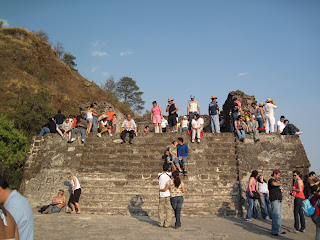
 And the spirits (as well as a lot of tourists) can look down on the places where modern man prefers to dwell.


