The words came but they had no mouths
And the world wasn't listening
only waiting
with us
Hearing the sound of always open doors sudden shut tight
too late no se
Not a land, not some dirt, but a culture
paralized, altered, evolved
with no mouths and kissing from the feet
He was waiting
wearing his hands away with disinfectant
poisined from the constant mercury
in his waiting mouth
Wait and see no se
no see when the eyes are covered too
a war against your neighbor
breeds bad energy, bad cells
sabes Senor?
get sick get well hang around oil wells
we don't say anything
but wait and see wait and se
Wednesday, April 29, 2009

Monday, April 20, 2009
La Villa (where our Lady is in the house)
A decade after the Spanish brutally supressed the Mexica and established their New World, an indegineous peasant named Cuauhtlatoatzin at birth and Juan Diego at baptism had an apparition of the Virgin Mary at the hill of Tepeyac north of Mexico City. Nevermind that his vision was identical to the earth goddess Tonantzin or that Tepeyac was a site of devotion for that pre-Colombian diety, it was Our Lady of Guadalupe more than anyone else who secured a place for Christianity in Meso-America and saved the Catholic Church from utter ruin in protesting Europe.
Today, her home is manifest in La Villa Bascillica, a sprawling complex of Churches, chapels, and more ambigiously programmed religious buildings on and around the hill of Tepeyac now engulfed by the northern sprawl of the city. After the Vatican, this is the most heavily visited site in Catholicism, with roughly 10 million coming to pay respects, gawk, and take photos each year. Around December 12 in particular, the feast day of Our Lady (and Tonantzin too), La Villa usually sees over a million of the faithful crowded into it's generous plaza.
 Although the colonial churches in the rest of Mexico City are usually underwhelming, La Villa boasts the best collection of them in the Distrito Federal. For example, the Capilla de Pocito, below.
 La Capilla de Cerrito is at the peak of the deceptively long stairway leading to the summit of Tepeyac. This is where Juan Diego saw and spoke with the Virgin. Unfortunately, while I saw the doors were wide open when I was standing in the plaza below, by the time I had climbed the few hundred odd steps it was closed.
 Yet my efforts were not in vain: the crest of Tepeyac offers one of the better views on the valley of Mexico. It happened to be one of the rare cloudy days of spring, and sunset to boot, but all the telltale signs of the vast yet limited bowl which some two dozen million call home were laid out clearly to the south, east, and west.
 The view above is foregrounded by the Templo Expiatorio a Cristo Rey of 1709 to the left, and the Basílica de Nuestra Señora de Guadalupe of 1976. El templo was the Bascilica for some 2 and a half centuries, but in light of its considerable list, and the fact that its dome is supported by the most heavily compacted scaffolding system I have ever seen (although a small portion of it is still open for adoration), that title was transfered to the modern addition by Arq. Pedro Ramírez Vázquez.
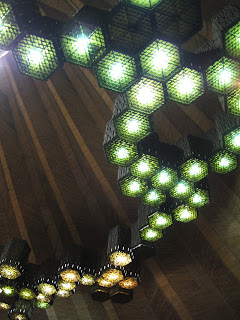
Ramírez Vázquez has left a considerable imprint on the capital (see the Museo de Anthropologia in my previous entry 'A Walk In The Park (El Bosque de Chapultepec)', for instance). His Basilica is a feat of both engineering and democratiziation of clerical space. The roof is suspended from a central spine, and it's underside is finished in a warm, inviting wood. This structural solution frees the space of columns and allows maximum, equal visibility of the altar, and the ORIGINAL tilma of Juan Diego which is also mounted on the central spine (if you are unfamiliar with the story of Juan Diego and his rosy tilma, look here). As much as I realize the fallacy of my tendency to make arbitrary comparisons, once inside the bascilica, I could not resist the suggestion that Ramírez Vázquez was perhaps making a three dimensional reality of a ubiquitous abstract theme from the renaissance. Take for instance, Piero della Francesca's Madonna of Mercy. While the faces inside the bascilica look different, they are every bit as devoted to Our Lady, and considering the emphasis placed on suffering in Mexican religious tradition, just as needful of her enveloping mercy as well.
 Despite these antique references, the place is not without it's uniquely modern curios. So great is the flux of visitors to the basilica that there is a sloping path tucked behind and beneath the altar to accomoadate the demand to gaze at the tilma without interupting the mass.
 Seeing the image of Our Lady all over Mexico, in addition to an increasing presence in the United States and elsewhere, zapped much of the aura from seeing the real deal. It doesn't look any different from the same image of adoration present in every church in this country. Nor is it strikingly different from various images of the Virgin and puti from contemporary Europe, but for the fact that her skin is of a slightly darker tone.
 I found more impressive the framing, the introduction of airport technology into sacred space (i.e. people movers), and, as usual at such places, the mob's obsession with taking the experience away with them. Truly, even in a church, the aura of art can be dispersed to non-existence.
To round this out, here are a few details of Ramírez Vázquez's fittingly baroque addition to La Villa.

 Adios.
 Monday, April 13, 2009
Tepotzlan
During one recent long weekend, I took the day trip to Tepotzlan, a nearby Pueblo to the south of the DF in the state of Morelos. Besides its Neve (akin to ice cream), which I couldn't do justice here for the fact that taste has yet to be replicated online, and that I didn't actually try any when I was there, Tepoztlan is known for a sprawling 16th century ex-convent in its center nestled in the little valley.

 BUT, the town is famous for its little late Aztec era pyramid pearched atop the edge of the valley. If you look closely at the image below, you can just make out the tell tale straight lines of human intervention on the ridgeline.


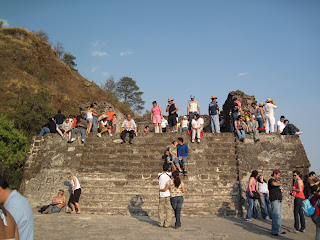
 BUT, the town is famous for its little late Aztec era pyramid pearched atop the edge of the valley. If you look closely at the image below, you can just make out the tell tale straight lines of human intervention on the ridgeline.
It's an often steep and always rocky one hour climb to the top, and as this was a puente (literally, a bridge, figuratively, a long weekend), the path had the added burden of being extremely populated. I had left the city to avoid the crowd, only to find a place even more densely habited, albeit temporarily.
And then I thought again, as I had a Mesa Verde, 'WOW, what were you guys thinking when you put that thing up there?'

Certainly a runt in comparison to most of the pyramids in Mexico, even the middling ones, but there a few places which can claim as stunning a location (or probably as harrowing a tale of construction).
 And the spirits (as well as a lot of tourists) can look down on the places where modern man prefers to dwell.
Saturday, February 14, 2009
UMAC
I woke up with a raging hangover and then I look outside and saw it was snowing. Snow in Mexico? How strange. And then I noticed is was very gray and dense, and then I saw the cloud. The horizon, usually filled with blue green mountains or light gray haze were full of billowing dark clouds. And they weren't just going up. That cloud was coming at me like a tidal wave. So I ran to the hall and shut the door and thought it could really keep me safe from the super hot, super fast pyroclastic cloud coming to ruin my Saturday.
And then, I woke up for the second time. This time I had a hangover too, not quite as bad, and the sky was sunny and clear, reminding me that is was Saturday and there was no way I was going to sleep in that greenhouse. Ok, so I got up, and while yesterday I planned to stay at home and do all these things I felt very crucial, as usual, I just couldn't stand to be in this house any longer than I need for minimal rest and hygene. Since I had missed the Espacio Escultura the last time I was at UNAM, I decided today would be the day to finally see it.
After a sticky, sickening metrobus ride, I found myself faced again with a locked gate in front of the Espacio. It seems as though this a place that only students and housewives could every hope to visit. But since I was already there, I decided to check out the Cultural University, just south of UNAM. What I found there was a different kind of sculptural space, a microcosm of the Espacio. That is, while the former is a large rationale sculptural piece in a wild ecological reserve, the later is a series of scultpures dispersed around a wild patch of growth. This would never happen in the US, as I saw several people climb to the top of those pink towers. I have come to realize that while we have a plethora of rights in the US, we haven't really much liberty.

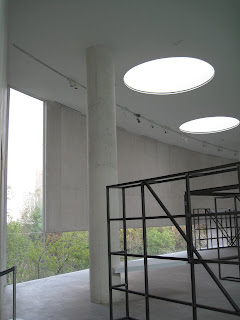
Afterwards, I was very happy to see Teodoro Gonzalez de Leon's recently opened UMAC (Universidad Museo de Arte Contemporaneo). It's great that the city now has a venue like this, as the only other before this was the Museo de Rufino Tamayo (another Gonzalez de Leon), and that, besides being rather petitie, has only been around since 1980. The entrance facade is the most stunning part, but the parti is very clear and works well for a museum. It is large but managable (I saw everything in about 2 hours). The details are sorely lacking, as was a good part of the work on display, but overall, it's a worthy addition to the city.


For the architecturally inclined, study the above photo to see the plan.

And then, I woke up for the second time. This time I had a hangover too, not quite as bad, and the sky was sunny and clear, reminding me that is was Saturday and there was no way I was going to sleep in that greenhouse. Ok, so I got up, and while yesterday I planned to stay at home and do all these things I felt very crucial, as usual, I just couldn't stand to be in this house any longer than I need for minimal rest and hygene. Since I had missed the Espacio Escultura the last time I was at UNAM, I decided today would be the day to finally see it.
After a sticky, sickening metrobus ride, I found myself faced again with a locked gate in front of the Espacio. It seems as though this a place that only students and housewives could every hope to visit. But since I was already there, I decided to check out the Cultural University, just south of UNAM. What I found there was a different kind of sculptural space, a microcosm of the Espacio. That is, while the former is a large rationale sculptural piece in a wild ecological reserve, the later is a series of scultpures dispersed around a wild patch of growth. This would never happen in the US, as I saw several people climb to the top of those pink towers. I have come to realize that while we have a plethora of rights in the US, we haven't really much liberty.

Afterwards, I was very happy to see Teodoro Gonzalez de Leon's recently opened UMAC (Universidad Museo de Arte Contemporaneo). It's great that the city now has a venue like this, as the only other before this was the Museo de Rufino Tamayo (another Gonzalez de Leon), and that, besides being rather petitie, has only been around since 1980. The entrance facade is the most stunning part, but the parti is very clear and works well for a museum. It is large but managable (I saw everything in about 2 hours). The details are sorely lacking, as was a good part of the work on display, but overall, it's a worthy addition to the city.


For the architecturally inclined, study the above photo to see the plan.


Saturday, February 7, 2009
Guanajuato
Last weekend, I was in Guanajuato.
A more thorough post is coming, but for now, enjoy these terse descriptions
 A panorama from the city's pantheon, or cemetery if you like...
 There are lots of tunnels under the city. Here is the entrance to one. It is like an ant farm.
 And it's also very colorful.
 Neoclassical and baroque.
 Is it a cathedral or a delicious cake?
 And their's a university my mother would hate.
 There's a market designed by that Eiffel guy.
 And mummies too. Lots of them.
 And the Mexican War of Independence kind of started here in this boring building.
 And had something to do with this guy.
 This is his eternal view. Not so bad...
A more thorough post is coming, but for now, enjoy these terse descriptions
 A panorama from the city's pantheon, or cemetery if you like...
 There are lots of tunnels under the city. Here is the entrance to one. It is like an ant farm.
 And it's also very colorful.
 Neoclassical and baroque.
 Is it a cathedral or a delicious cake?
 And their's a university my mother would hate.
 There's a market designed by that Eiffel guy.
 And mummies too. Lots of them.
 And the Mexican War of Independence kind of started here in this boring building.
  And had something to do with this guy.
 This is his eternal view. Not so bad...
Monday, February 2, 2009
SISMO!
It has finally happened.
Saturday morning around 7:30 AM I woke up and felt the sensation of rocking. And I looked over and saw the shirts hanging in my open closet rocking back and forth and then HOLY SH|T an earthquake!
Well, it turned out to just be a harmless tremor, pretty common around here, but it's the first time I've concously noticed one, here or elsewhere. For those of you who do not know the experience, there is certainly no better way to get one up and out of bed wide awake than for the earth to shake your concrete building a little.
For those overly concerned, fear not. The room I sleep in survived the big one in 1985, so unless there's one worse, it will survive these little shakes and I'll sleep safe and sound.
But WOW, that's a humbling feeling.
Saturday morning around 7:30 AM I woke up and felt the sensation of rocking. And I looked over and saw the shirts hanging in my open closet rocking back and forth and then HOLY SH|T an earthquake!
Well, it turned out to just be a harmless tremor, pretty common around here, but it's the first time I've concously noticed one, here or elsewhere. For those of you who do not know the experience, there is certainly no better way to get one up and out of bed wide awake than for the earth to shake your concrete building a little.
For those overly concerned, fear not. The room I sleep in survived the big one in 1985, so unless there's one worse, it will survive these little shakes and I'll sleep safe and sound.
But WOW, that's a humbling feeling.
Puebla y Cholula
I found myself in Puebla last weekend by both desire and chance: desire to see the famous village of the angels, and chance that I could hitch a ride down one of the nicest, though not so free, highways in Mexico. After about and hour trying to get out of the city, which gave me a glimpse of both the highly recommended Xochimilco swamp/park and some of the cancerous concrete sprawl without a tree to be seen in the foothills on the outskirts of the city (I guess that is where the millions and millions live), we were well on our way out of the basin of Mexico and into states unknown. It takes about an hour to get there, and to occupy myself on the way, I gawked at the twin peaks of Iztaccíhuatl and Popocatépetl. So named for some pre-Colombian legend I am unfamiliar with (although I believe the is a kitsch painting of the title characters in just about every Mexican restaurant in Kentucky). Popo is an active volcano, and spews a little smoke constantly, and sometimes enough to leave a light 'snowfall' of ash. It's really mindblowing, especially that millions of people live within the eminent reach of it's pyroclastic flow which will most certainly come in a matter of time. Passing between the two is like driving through Colorado, with high peaks, steep slopes, and majestic old pines I'd love to get to familiar with.
While the drive is not exactly the Mexico of my childhood imagination, Puebla is certainly more in line with that vision. Passing through fields of horse drawn carts and hand-hoed fields (and there are no Amish here I'm aware of), we finally arrived in the historic center of Puebla. A stopover between the old port city of Vera Cruz and the capital, Puebla was the only one of the colonial cities of any size not founded around an indeginous precedent. Such a tabula rasa condition explains why it is perhaps the most perfect execution of the Law of the Indies around. Here is a grid, a perfect matrix, that unlike the more utilitarian New York example is both more humanly accessible and more sure of it's center: the well shaded, highly activated Zocalo. Smaller in scale than it's neighbor in the DF, it is nevertheless more tranquil and accessible, full of trees and monuments. That there is a massive old Cathedral goes without saying, although it faces west, giving it's flank to the Zocalo and providing a somber backdrop to any one of three shows given by the many many clowns in the city.
 The Zocalo is, like it's big city cousin, surrounded by arcaded passages. And there is one passage glued to the audacious 19th beaux arts municipal palace. And unfortunately, because my battery died immediately after I took this picture, and it is one of the rechargable lithium types that are supposed to last longer than the double AAs, this is the last of the pics you'll get from this whole trip. So, if you want to read further, you'll just have to put up with a few thousand words.
 There are several other great 19th century buildings in the city, and also many markets, both for food, artesan crafts, and mass produced everyday goods, each with its own home in its own quarter of the city. And there are some great churches, much better than the rather monotonous, disappointing lot in the center of the DF. The Cappella del Rosario in the Templo de Santo Domingo is covered top to bottom with gold on an undulating textured surface that you can easily fool yourself into believing is moving like the pit of snakes in Raiders of the Lost Ark. In the words of a good friend, it is Bernini on Acid. And in an act of the surreal and the profane, while I was standing outside admiring the chapel and the wedding going on inside, I caught sight of a small, red spot on the otherwise glimmering gold surface(s) and recognized it immediately as helium filled Spiderman head, out of reach to all but the angels.
I had some great Pechuga con Mole in a place called La Fonda de Santa Cruz (which is nowhere near the ex-Convento de Santa Cruz and the myriad of candy stores bearing the name Santa Cruz). Pechuga con Mole on the English menu is translated as 'Breast with Mole', not exactly the most appetizing of images, but if you like the almost chocolatey taste of Mole, then it does justice to the reputation of the city as the best for the dish.
As I was wandering in the northern quarter of the city I saw a light on at the end of a block and thought to myself, well here's a bar, perhaps I'll check it out. As I got closer, however, I saw a few patrons but no drinks and no bar, but only coffins. And then I saw another place across the street, also filled top to bottom with homes for the dead. And above these stores I saw the sign '24 hrs'. I suppose that historically in such a warm climate it has been imperative to take care of the dead with speed. Ironically enough, I just finished 'As I Lay Dying' in which a similar situation is not attended to with much speed and I can see why there might be a market for such things in the wee hours of the morning.
Well, I hightailed it out of there to another quarter where I did find a nice bar, sans coffins, and with something even more fun: live music. I took in a few chelas and a set and as I made my way out to get back to the hotel I saw something that is straight out of my childhood dreams of Mexico. Now, I had a few drinks, but I swear I saw two horsemen replete with big sombreros riding down the street and one had an open bottle of Chivas Regal. The only thing missing were some pistol shots in a cantina.
One cannot escape the feeling of the abstract in Puebla, as the grid is so overwhelming, both as a physcial atmosphere and in the nomenclature of the quarters. The numbered, directional names of the streets '3 West', '4 North', for example, are pulled straight from my Pre-Calculus class. If I threw a few parabolic curves on an inverted map there and talked about what could happen in the interstices left by such a superimposition, especially with regard to the various aforementioned markets, I could do quite well in some upper level design studios of a few years ago in my university.
And lest I forget, I also got over to Cholula, that for all the sprawl is like suburban anywhere USA, is essentially the same city as Puebla. Unlike Puebla, Cholula was a pre-Columbian site before the Spaniards arrived to spoil the party. Although only a town today, in 1519 it was second only to Tenotchtitlan in population in the whole of central Mexico. But not to be outdone, the Cholulans boasted not only the largest pyramid in Mexico, but the largest by volume in the entire world. This is still highly visible today, although as it had fallen out of use even by the time the Spaniards arrived, nature has largely reclaimed it and it looks more like a pimple of a hill today with a quaint orangish-yellow church on top. From that church there is a great view of the entire landscape: the Cathedral of Puebla in the near distance, the ominous doom foretold by Popo's bad habit, the various, colorful churches of Cholula (supposedly one for each day of the year, though from my observations, I find that unlikely), and the Zocalo. The Zocalo here is also well shaded, and is arcaded on one side by shops and restaurants (one of which serves an amazing churro relleno con zarzamora). Opposite los portales are two churches which are so old you can see in them the traits typical of the transition from medieval to classical dispositions which are usually only to found in those parts of Europe which weren't detroyed not so long ago. And speaking of senseless death and destruction, the Zocalo in Cholula was also the witness to a massacre of the locals by Cortes and his Tlaxcalan allies. Official histories typically cite this as a battle, but let's not forget that winners write those and power has always, even to this day, used lies and deceit to further it's aims.
While the drive is not exactly the Mexico of my childhood imagination, Puebla is certainly more in line with that vision. Passing through fields of horse drawn carts and hand-hoed fields (and there are no Amish here I'm aware of), we finally arrived in the historic center of Puebla. A stopover between the old port city of Vera Cruz and the capital, Puebla was the only one of the colonial cities of any size not founded around an indeginous precedent. Such a tabula rasa condition explains why it is perhaps the most perfect execution of the Law of the Indies around. Here is a grid, a perfect matrix, that unlike the more utilitarian New York example is both more humanly accessible and more sure of it's center: the well shaded, highly activated Zocalo. Smaller in scale than it's neighbor in the DF, it is nevertheless more tranquil and accessible, full of trees and monuments. That there is a massive old Cathedral goes without saying, although it faces west, giving it's flank to the Zocalo and providing a somber backdrop to any one of three shows given by the many many clowns in the city.
 The Zocalo is, like it's big city cousin, surrounded by arcaded passages. And there is one passage glued to the audacious 19th beaux arts municipal palace. And unfortunately, because my battery died immediately after I took this picture, and it is one of the rechargable lithium types that are supposed to last longer than the double AAs, this is the last of the pics you'll get from this whole trip. So, if you want to read further, you'll just have to put up with a few thousand words.
 There are several other great 19th century buildings in the city, and also many markets, both for food, artesan crafts, and mass produced everyday goods, each with its own home in its own quarter of the city. And there are some great churches, much better than the rather monotonous, disappointing lot in the center of the DF. The Cappella del Rosario in the Templo de Santo Domingo is covered top to bottom with gold on an undulating textured surface that you can easily fool yourself into believing is moving like the pit of snakes in Raiders of the Lost Ark. In the words of a good friend, it is Bernini on Acid. And in an act of the surreal and the profane, while I was standing outside admiring the chapel and the wedding going on inside, I caught sight of a small, red spot on the otherwise glimmering gold surface(s) and recognized it immediately as helium filled Spiderman head, out of reach to all but the angels.
I had some great Pechuga con Mole in a place called La Fonda de Santa Cruz (which is nowhere near the ex-Convento de Santa Cruz and the myriad of candy stores bearing the name Santa Cruz). Pechuga con Mole on the English menu is translated as 'Breast with Mole', not exactly the most appetizing of images, but if you like the almost chocolatey taste of Mole, then it does justice to the reputation of the city as the best for the dish.
As I was wandering in the northern quarter of the city I saw a light on at the end of a block and thought to myself, well here's a bar, perhaps I'll check it out. As I got closer, however, I saw a few patrons but no drinks and no bar, but only coffins. And then I saw another place across the street, also filled top to bottom with homes for the dead. And above these stores I saw the sign '24 hrs'. I suppose that historically in such a warm climate it has been imperative to take care of the dead with speed. Ironically enough, I just finished 'As I Lay Dying' in which a similar situation is not attended to with much speed and I can see why there might be a market for such things in the wee hours of the morning.
Well, I hightailed it out of there to another quarter where I did find a nice bar, sans coffins, and with something even more fun: live music. I took in a few chelas and a set and as I made my way out to get back to the hotel I saw something that is straight out of my childhood dreams of Mexico. Now, I had a few drinks, but I swear I saw two horsemen replete with big sombreros riding down the street and one had an open bottle of Chivas Regal. The only thing missing were some pistol shots in a cantina.
One cannot escape the feeling of the abstract in Puebla, as the grid is so overwhelming, both as a physcial atmosphere and in the nomenclature of the quarters. The numbered, directional names of the streets '3 West', '4 North', for example, are pulled straight from my Pre-Calculus class. If I threw a few parabolic curves on an inverted map there and talked about what could happen in the interstices left by such a superimposition, especially with regard to the various aforementioned markets, I could do quite well in some upper level design studios of a few years ago in my university.
And lest I forget, I also got over to Cholula, that for all the sprawl is like suburban anywhere USA, is essentially the same city as Puebla. Unlike Puebla, Cholula was a pre-Columbian site before the Spaniards arrived to spoil the party. Although only a town today, in 1519 it was second only to Tenotchtitlan in population in the whole of central Mexico. But not to be outdone, the Cholulans boasted not only the largest pyramid in Mexico, but the largest by volume in the entire world. This is still highly visible today, although as it had fallen out of use even by the time the Spaniards arrived, nature has largely reclaimed it and it looks more like a pimple of a hill today with a quaint orangish-yellow church on top. From that church there is a great view of the entire landscape: the Cathedral of Puebla in the near distance, the ominous doom foretold by Popo's bad habit, the various, colorful churches of Cholula (supposedly one for each day of the year, though from my observations, I find that unlikely), and the Zocalo. The Zocalo here is also well shaded, and is arcaded on one side by shops and restaurants (one of which serves an amazing churro relleno con zarzamora). Opposite los portales are two churches which are so old you can see in them the traits typical of the transition from medieval to classical dispositions which are usually only to found in those parts of Europe which weren't detroyed not so long ago. And speaking of senseless death and destruction, the Zocalo in Cholula was also the witness to a massacre of the locals by Cortes and his Tlaxcalan allies. Official histories typically cite this as a battle, but let's not forget that winners write those and power has always, even to this day, used lies and deceit to further it's aims.
Subscribe to:
Posts (Atom)